

Blog 49 1926 Chatham Kent - Hung for the murder of Rosie Smith

Rosie Smith, a promiscuous woman who seemed to enjoy the company of military men until she became the victim at the hands of a veteran.
LIFE STORY OF ROSE
Rose Smith was born on 31 January 1884 in Chatham to George Benton, a 44 year old farm labourer and Army pensioner and Maria Hellmouth 25 years old from Windsor. She was the youngest of four daughters.
Rose was three when her father died aged 47 on 17 February 1887 from Phthisis Asthenia. A year later, on 19 February 1888, her mother married Albert Edward Templeton, and they had another daughter and two sons together.
Although official records listed the girls as Templeton, people still referred to them as the stepchildren.
On 3 June 1905, when she was 21, Rose married 19-year-old Charles Albert Rhodes at St John's Church in Chatham. Charles served in the Royal Marine Light Infantry at the Chatham Division.
On 4 June 1909, Rose gave birth to their son, Albert James.
Charles was often away at the barracks, and during that time, Rose was unfaithful and reportedly had affairs with other military men.
On 23 January 1911, when Rose was 26, she gave birth to a daughter named Rose Norah Violet, but the baby was given the surname Callaghan. By the 2 April 1911 census, Rose was living at 33 Church Street, Chatham, with a boarder, 22-year-old John Callaghan, an able seaman in the Royal Navy. Charles was likely away on duty. Baby Rose was given the Rhodes surname on the census but was baptised on 19 July 1911 at St John's Church, with Rose using the surname Callaghan and naming John as the father. Their daughter died on 22 July 1911 at 1 James Street in Chatham, the death was recorded under the surname Rhodes and was reported by M.A. Milward, who was present at the death and also lived at the address. The cause of death was Enteritis, which is inflammation of the small intestine. It is most commonly caused by food or drink contaminated with pathogenic microbes, such as Serratia.
On 27 November 1913, Rose was charged at Maidstone court with procuring a girl for unlawful purposes, but she was acquitted.
On 23 March 1915, Rose gave birth to another daughter, Lilian Rose Florence Rhodes, at 31 Springfield Road, Gillingham, Kent. On 20 June 1915, she was admitted to the Medway Union house for unknown reasons but was discharged 10 days later. Then, on 27 August 1916, at 1 Swaffers Alley in central Chatham, she gave birth to Rose Mary Kathleen Rhodes.
On 15 July 1918, Charles filed for divorce, probably realising he was away when the children were conceived and that Rose had relationships with other men. She may have admitted this and blamed his absence.
In January 1919, Rose gave birth to another daughter, Alice Hannah Benton.
On 7 April 1919, the divorce proceedings between Charles and Rose began. Charles accused her of adultery with unknown men while he was away on service, and claimed she had two children from these affairs, naming Lilian and Rose. He also requested full custody of his son.
The Decree Nisi was finalised on 30 May 1919, followed by the Decree Absolute on 18 December 1919.
Albert, aged 10 when his parents divorced went to live with Rose's sister, Minnie, who was a year younger than Rose. She was married, with no children. Minnie's husband, William Skinner, worked as a wireman at the Chatham dockyard. They had a domestic servant, and Albert attended school, giving him a stable home life.
In 1921, Rose, age 37, was living at 36 Cross Street, Chatham. She still used the surname Rhodes and listed herself as married. Her daughters, Rose, age 4 years 10 months, and Alice, age 2 years 5 months, lived with her. Her eldest, Florence, age 6 years 5 months, was living at the Foundling Hospital children's home on Guilford Street, St Pancras, London.

The 1921 census also showed that Rose had a 69-year-old female boarder named Fanny Rebecca Cabbage, whose occupation was listed as home duties. There was also a visitor, 30-year-old William Jarrett, who was a Chief Stoker on HMS Pembroke.
In July 1922, at age 38, Rose married 21-year-old Herbert Smith. He was a soldier in the Royal Garrison Artillery at Dover Castle.
In September 1925, Rose took in another lodger, Harry Thompson. While her husband was away on duty, she and Harry soon began a relationship.
LIFE STORY OF HARRY
Harry, born as Henry Thompson on Dec 2 1887 in Middlesbrough, Yorkshire. The youngest of three children born to Samuel Thomson, a labourer, from Malton, Yorkshire and Eva Freshwater, from Bedfordshire.
When Harry was Three, on August 31 1891, his mother died aged 31. She had been suffering for four years from disease of the fallopian tubes and ovaries and was having an operation to remove them but died after 1 day.
His father worked as a gas stoker and remarried on December 26 1892, at age 42, to 22-year-old Annie Maria Rowell from Brompton, Yorkshire. They had two sons, William (born 1894) and John Gordon (born 1895).
They were living at 5 Childers Street in Middlesbrough when his brother John died, age four on March 18 1900, from Broncho Pneumonia and the marriage ended not long after.
Samuel moved into lodgings in Harrogate Yorkshire with his two children, Harry, then 14, and William, aged 7, his other older children with Eva, Robert 15, went to live with his Aunt and Uncle and daughter Alteria Eva age 16 became a live-in servant.
On January 19 1910, at age 22, Harry joined the Royal Marine Light Infantry at the Chatham Division and on November 26 1913, he transferred to the Royal Navy. From 1914 to 1917, he served on the HMS Dominion, a vessel that defended the home ports, which took him to Wales.
In October 1916, at age 28, Harry married 17-year-old Gladys Rogers in Pontypridd, Glamorganshire. On June 3 1918, Gladys gave birth to their daughter, Phyllis, in Caerphilly, and in September 1919, their daughter, Marjorie, was born.
Gladys stayed at her family home at 1 Railway Terrace, Caerphilly. Her father and brothers worked for the railway.
When Harry left the Military in 1920, he moved into Railway Terrace and became a coal miner for the Cardiff Coal Company. The 1921 census shows him living with Gladys and their two daughters. On July 14, Gladys gave birth to their son Cyril; Beryl Lorraine followed in January 1923, and another son, Novello, in 1924.
Some time later, for reasons unknown, Harry left his wife and young children and returned to Chatham.
He found work as a main drainage labourer and moved into Rose Smith's lodgings in September 1925.
THE CRIME
On Monday February 9, 1926, just after ten at night, Harry was seen walking up Chatham High Street, fully dressed except for a hat and shoes, and holding a razor. He approached George Varney, who was standing outside his shop, and told him he wanted to surrender. Mr Varney, who did not know Thompson, advised him to go to the police station, but Harry said he would only go if Varney went with him. Realising the seriousness of the situation, and seeing the razor and Harry’s hands covered in blood, Varney took him to P.C. Best, who was on duty at the bottom of Clover Street. Harry made another statement to P.C. Best, who then escorted him to the police station.
Superintendent W. G. Paramour questioned Thompson, then went to 36 Cross Street, near The Brook and the intersection of King Street and Slickett's Hill. When he entered the house, he found Rose Smith lying at the foot of the kitchen stairs, her head almost severed.
It seemed there had been a quarrel in the house, and the children were heard screaming. Little Rose, age 9, ran to the home of Mrs Tanton, their next-door neighbour, and shouted, “Uncle is doing something to mother.” Mrs Tanton went into the house and saw Harry holding a razor. When she asked what was happening, Harry said something about “things being finished” and hinted he was going to cut his own throat. Mrs Tanton persuaded him to go to the police, and Harry left the house.
Rose's husband, Chief Petty Officer Herbert Smith, was serving on H.M.S. Venomous at a foreign station. Superintendent Paramour contacted the Home Office about the tragedy.
THE INQUEST
An inquest was opened by the County Coroner (Mr E. C. Harris) on the afternoon of Friday February 13 at the Town Hall, Chatham. The body of Rose Smith lay in the mortuary, where it was first viewed by the jury, which comprised the following gentlemen:
Mr Arthur Stanley Ferguson (foreman), Mr Edward Henry Tremaine, Mr William Edworthy, Mr Douglas John Bradshaw
Mr George William Bailey, Mr John Black, Mr Andrew Terenzy, Mr William Dawson, Mr George Smith.
Albert Edwin Templeman of Rose Bungalow, Chestnut Avenue, Walderslade, a general labourer, identified the body as that of his step-daughter, Rose.
The Coroner: ''You know nothing of this affair?''
Albert: ''No, sir.''
The Coroner: "Had you seen her recently?''
Albert: ''On Saturday night and Sunday night.
The Coroner: ''Did she say anything to you?''
Albert: ''She was up for tea. She seemed lively enough, but she said nothing to me at all''
Next witness was Dr James Isaac Lyons, Railway Street, Chatham,
''At about 10.50 p.m. on the day in question, I was called by the police to 36, Cross Street, Chatham. I saw the deceased, whom I knew as Mrs Smith. She was quite dead. The cause of death was haemorrhage and asphyxia as a result of an extensive wound in the neck caused by a sharp instrument, such as a razor.”
The Coroner: ''Could the wound have been self-inflicted''
Dr Lyons: ''It is absolutely impossible.''
The Coroner: ''Would death have been almost instantaneous?''
Dr Lyons: ''Yes, sir.''
The witness then said he had since made a post- mortem examination of the body.
“I found a wound extending around two-thirds of the neck and down to the spinal column, which bore the impression of a razor. The great blood vessels of the neck, the voice box, the gullet, and the large muscles of the neck were severed. The wound was caused by repeated to-and-fro movements of a sharp instrument, such as a razor. The deceased was a well-nourished, healthy woman, and all her organs were healthy.
The Foreman: ''How long do you think the woman had been dead?''
Dr Lyons: ''About an hour.
Supt. W.G. Paramour then deposed:
“At 10.30 p.m. on 8 February, Harry Thompson, who is now in custody, was brought to the police station by P.C. Best. The constable made a report to me and handed me a razor.''
He then stated that he said to Thompson. “The constable reports you say you have cut a woman's throat. Will you tell me where the house is? " He replied, “I will tell you nothing. I have just told him (Best)” he then complied, “It is 36, Cross Street. It is not my wife; it is only a woman I know. I have cut her head right off. So there you are.”
Supt. Paramour said he then at once went to 36, Cross Street, and the first constable he met on the way, he sent off to get the police surgeon. On arrival, he said he found the body of the deceased at the foot of the stairs leading into the living room. The head was nearly severed from the body. The body was warm, but life extinct,
The Coroner: ''As a result of what you saw, did you soon afterwards charge Thompson?
Supt Paramour: ''I returned to the police station about 12.20 a.m. I saw Thompson and cautioned him.”
The Coroner: “I don't think I will go into all that on this occasion. You saw Thompson and subsequently brought him before the Justices on a charge of murder?''
Supt Paramour: ''Yes, and he is now remanded in custody until Monday.''
Addressing the jury, the Coroner said: ''That is as far as we ought to take the case today. I daresay you have observed for yourselves, from recent murder cases, that judges favour the principle that there should not be two enquiries proceeding concurrently for various reasons. So far as my enquiry goes, I am only concerned with the cause of the death of the deceased. The evidence in my Court might not be evidence in a Criminal Court; therefore in justice to any prisoner it is one of the reasons judges deprecate two enquiries being conducted at the same time, There are other reasons, too, and before many years I expect it will become law for these inquests, where there is a definite charge of murder and someone is in custody, to be adjourned until after the trial of the person accused. That being so, and the trial being fixed for next week, I think it will be convenient for us to adjourn until after the Assizes.
POLICE COURT
At Chatham Police Court on Monday, 15 February, Harry Thompson was brought before Mr Robinson F. Gibson. When the Magistrate's Clerk (Mr P. T. Baker) formally charged him with the wilful murder of Rose Smith, and Harry replied, "I DID IT; I AM GUILTY. All I have to say is, I did it; I am guilty, and will be as game to go and out myself, the sooner, the better. I don't think I made many mistakes in it either, to the evidence, did I?"
While before the Magistrate, he seemed unconcerned, often smiling and even laughing at times. Only once did he falter—when one of Rose's daughters looked at him, he became emotional and turned his eyes away.
His face beamed with smiles when he was asked if he wished to question the last witness called for the prosecution, George Pocock, the licensee of the Three Cups public house in Brook, and he responded, "Well, I was going to ask him for a drink, but I don't think it is much use. I would like to ask him for a bottle of stout: I could do with it."
Mr Gibson directed that the prisoner take his trial on the charge of murder at the next Assizes at Maidstone.
THE FUNERAL
Rose's funeral took place on Tuesday, February 17. The scene was described as both moving and somber. Around noon, a large crowd, mostly women and children, gathered at the mortuary gates in Chatham to see the body taken for burial. When the motor hearse and two coaches carrying her husband, Chief Petty Officer Herbert Smith, and other relatives arrived, the crowd fell silent. The body was placed in the hearse with care. As the procession left, people removed their hats in respect. Many women in the crowd cried as the coffin, decorated with a few flowers, was taken to Palmerston Road Chatham Cemetery. Spectators lined the route, and a large group gathered at the graveside. The Rev. F. Wiltshire of St Mary's, Chatham, performed the last rites, and the coffin was lowered into the ground. The silence was broken only by the sound of the wind, rain, and the sobs of several women. Rose's mother, in deep despair, had to be supported by her husband and son-in-law. She said her final goodbye as the coffin was lowered. The main mourners included her husband, stepfather, mother, sister Mrs Lowery, and Mr and Mrs Charles. Friends and neighbors threw bunches of white flowers onto the coffin.
CRIMINAL COURT CASE
On February 27, the Kent Assizes were opened at Maidstone before Justice Thomas Gardner Horridge.

In his charge to the Grand Jury, His Lordship said that the day was certainly not a heavy one, and there was one feature which gave him unqualified pleasure to refer to, and it was that among the charges there was not a single charge of an indecent character, and that spoke very well for the County.
It was generally understood that Thompson intended to plead guilty to the charge, and on Friday, his Lordship asked Mr Reginald Sharpe to take up the case on the prisoner’s behalf. Several interviews took place between the judge and counsel during the day, and on Saturday morning, when called on to plead, the prisoner accepted with advice of his counsel and pleaded not guilty.
He was allowed to be seated in the dock, and for the greater part of the time, he sat with his arms folded, listening attentively to the witnesses.
During the earlier part of the hearing, Lady Horridge and several other ladies, one wearing a large bunch of violets, sat on the Judge's left. Mr Gervais Rentoul, M.P., conducted the prosecution, and, as stated, Mr Reginald Sharpe appeared for the prisoner.
The witnesses who gave evidence at Chatham repeated their evidence, and in cross-examination, one or two fresh points were elicited.
First in the witness box was Albert Edward Templeman, stepfather, who gave his evidence at the inquest and was cross-examined by the defence.
Mr Sharpe: “She was of rather a fiery temper, wasn't she?”
Albert: “She was fiery.”
Mr Sharpe: “And I suppose you have heard of domestic rows she had with Thompson?”
Albert: “No.”
Mr Sharpe: “Was her married life with Herbert Smith quite calm and peaceful, so far as you know?”
Albert: “Yes, no trouble at all?”
Mr Sharpe: “Does the same apply to her life with Rhodes, from whom she was divorced?”
Albert: “Yes”
Mr Sharpe: “You must know there were continual rows between her and Rhodes?”
Albert: “No”
Mr Sharpe: “Knowing she was of a fiery temper, you would not be surprised if there were rows?”
Albert: “What I mean by fiery is that she was a woman who would always take her own part”
Mr Sharpe: “Not only take her own part, but be the aggressor sometimes?''
Albert: “I can’t say.”
Mr Sharpe: “Would you be surprised to hear that she and Thompson had a number of serious rows?”
Albert: “I can't say anything about Thompson, because I did not know the man, and did not know they were together.”
Mr Sharpe: “Leaving Thompson out of the question for a moment, from what you know of Rose Smith, would you be surprised to hear there had been a number of serious rows?''
Albert: “I have seen nothing in that way myself.”
Next was Frederick George Garnett, a labourer, living at 38 Cross Street, Chatham:
“At about 10 pm on 8 February, I heard screams from No 36, Cross Street, and on going out, heard the prisoner say, ‘It is all over; it is done with’. Afterwards, I went into the house with Mrs Tanton and saw the deceased lying at the foot of the kitchen stairs in a pool of blood.
Cross-examined, the witness said he knew Rose Smith as a neighbour and had been in her house at Christmas time. Thompson was there, but he only knew him by sight. He had not heard quarrels between Thompson and the deceased.
Mr Sharpe: “Had Rose Smith any reputation amongst the neighbours of being a little hot-tempered?”
Frederick: “No. There had only been rows amongst the children.”
Next witness was Mrs Amelia Tanton, the neighbour from 38, Cross Street, Chatham:
“I heard nothing at No. 36 until the children came into the yard screaming. I had known Mrs Smith for seven or eight years, and Thompson, once he came to live at the house in September last.”
The next witness would have been Rose Smith, the eight-year-old daughter of the deceased, but his Lordship said he did not think her evidence was necessary. It was very undesirable to call a child of eight. Mr Rentoul agreed, and the child was not called.
George Edward Thomas Varney was called and gave his address as 233, High Street, Chatham, and his occupation was a pastry cook.
He described how the prisoner came up to him in the High Street at 10.15 pm., without hat or boots, and said, “Hello, George, I have cut Rose's head clean off”, and afterwards he took him to P.C. Best.
The next witness was P.C Best:
He said he was approached by the previous witness and the prisoner. When the prisoner came up to him at the foot of Clover Street, he said, “I have chopped a —— woman,” and on the way to the police station, he made the remark, “I hope I have cut her —— head right off.”
P.C. Best took a razor from the prisoner's hand. The prisoner laughed and joked, and at the police station started singing a Welsh song.
Cross-examined - P.C. Best said the prisoner may have had some drink, but he appeared to be rational.
Supt. W. G. Paramour was then called to the witness box:
He described how he found the deceased with a terrible wound in her throat and a cut on her hand, and the prisoner's demeanour at the police station when charged.
Cross-examined - he said he found signs of disorder in two rooms at 36, Cross Street. He found no other razor in the house. Thompson had not been convicted of violence, as far as he knew, and he knew Rose Smith only as a resident of Chatham.
Next, the medical evidence was heard from Dr James Isaac Lyons, from Railway Street, Chatham:
He said he was of the opinion the deceased’s throat was cut from left to right, and then the razor drawn to and fro across the throat. The first cut would have been sufficient to cause almost instant death without the subsequent sawing motion.
George Pocock, the licensee of the Three Cups public house in Brook, was called, and he said Thompson and Rose Smith had been to his house together. He had never heard a word out of place between them. They had never quarrelled in his house.
This closed the case for the prosecution.
The prisoner Harry Thompson then entered the witness-box.
He was described as a more callous prisoner who had rarely stood in the dock. There was a smile on Thompson's face throughout the trial, and the smile broadened when the doctor described the terrible injuries sustained by Rose.
He said he had never been charged with any sort of violence before. He moved in with Rose Smith in September.
The Judge: “Did you merely live in the house or live with her as your wife?”
Harry: “We were cohabiting.”
Mr Sharpe: “What sort of a woman was she?”
Harry: “She was all right when she was all right, but when she took a bad turn, she wanted a little bit of managing.”
Mr Sharpe: “You heard Mr Templeman say she had a fiery temper. Do you agree?”
Harry: “She was very violent when drunk. Oftentimes, we had a row.”
Mr Sharpe: “Were those rows ever of a serious nature?”
Harry: “lf I had taken them seriously, they would have been, but I used to get out of the way.”
Mr Sharpe: “How long before this Monday had you had a row?”
Harry: “We had one on the Saturday or Sunday night previously.”
Mr Sharpe: “Was that merely a matter of words?”
Harry: “She tried to hit me on the head with an ornament.”
Mr Sharpe: “Was anything broken or not?”
Harry: “She broke one ornament, but not the one she took to hit me with.”
Mr Sharpe: “Coming to the 8th, were you in work at the time?”
Harry: “No.”
Mr Sharpe: “Did you have occasion to go to the Labour Bureau that day?”
Harry: “Yes, just after three.”
Mr Sharpe: “After you came from there, did you go home?”
Harry: “I am not sure whether I went straight home or next door.”
Mr Sharpe: “I suppose you know the neighbours?”
Harry: “Yes, I know Mrs Tanton.”
Mr Sharpe: “What happened between tea time and 10 o'clock that night?”
Harry: “I could not say”
Mr Sharpe: “Have you any doubt, you did what has been described?”
Harry: “I don’t know. The first thing I can really remember is speaking to George Varney, but I don't remember where I met him.”
Mr Sharpe: “Can you help us at all by telling us what happened in the sitting-room or kitchen that evening?”
Harry: “I can’t remember what happened”
Mr Sharpe: “Afterwards, you know, you were found out of the house. You have heard what the various witnesses have said you said that evening. Is it right or not?”
Harry: “The expressions seem rather strange, because I am not accustomed to using that sort of language. I must have said something to them.”
Mr Sharpe: “You are not prepared to contradict them when they say you made these statements”
Harry: “No”
Mr Sharpe: “Did you cut Rose Smith's throat, meaning then and there to deliberately murder her?”
Harry: “I did not know what I had done until I was told”
Supt. Paramour produced the razor. “Keep it yourself,” observed the Judge
Mr Sharpe: “Is that razor produced one of yours?”
Harry: “Yes, I think so.” He looked at the razor, which Supt. Paramour held tightly and said, “Yes, that is my razor. I had several other razors which I kept in the kitchen.”
He was then cross-examined by the prosecution:
Mr Rentoul: “You are a married man?”
Harry “Yes.”
Mr Rentoul: “You have a wife and five children living in Wales?”
Harry: “Yes.”
Mr Rentoul: “You came to live with this woman, and do you say you frequently had violent quarrels?”
Harry: “Yes, pretty often.”
Mr Rentoul: “Quarrels in this house?”
Harry: “Yes.”
Mr Rentoul: “Can you suggest how it is you had these violent quarrels and no one ever heard them?”
Harry: “Were they asked if they heard any quarrels?”
Mr Rentoul: “I suggest they could not have been violent, or Mr Garnett would have been in a position to hear them?”
Harry: “He may not have been.”
Mr Rentoul: “You say you have no recollection of what took place on that night?''
Harry: ''Not after 4 o'clock.”
Mr Rentoul: “You don’t remember anything that took place until you found yourself talking to My Varney?”
Harry: “No”
Mr Rentoul: “Can you suggest how you came to get that razor?”
Harry: “No.”
Mr Rentoul: “You have no recollection of any quarrel or struggle?”
Harry: “No, not on that night.”
Mr Rentoul: “You heard Mr Garnett say he saw you pass out and heard you use the words, ‘it is all over; it is done with?”
Harry: “I heard him say it.”
Mr Rentoul: “Have you any recollection of using those words?”
Harry: “None whatever.”
That was the end of his questioning, and Harry then resumed his seat in the dock.
Mr Sharpe, in addressing the jury on behalf of the prisoner, said no amount of provocation would in any case justify anybody in killing another, but it might be in certain circumstances provocation would reduce what might otherwise be murder to manslaughter, not mere trivial provocation would be sufficient, but such provocation as would lead a reasonable person to lose self control, From the facts as they appeared it was undoubtedly possible for the jury to say that the prisoner was guilty of murder, but he would ask them with a great deal of confidence to say it was also possible to bring in a verdict of manslaughter. They must not shut their eyes to what must have been the character of this unfortunate woman. Her stepfather went to the length of saying she had a fiery temper. If he was preparing to go to that length, wouldn’t they be satisfied that she was really a violent person at times? The prisoner's view of her was that she was all right when she was all right, but that circumstances might arise when she was far from all right. He would ask the jury to say that the person who had met her death could at times be a very violent person indeed. The next thing he would urge was that the man charged with this murder was a man who had not committed any sort of violence upon anybody before. People did not do these things without reason. Had any reason been suggested why the prisoner should have committed this act? He failed to see any motive. He would ask the jury to consider further whether there might have been provocation. The evidence of one witness was that he found the premises in a state of disorder. The prisoner could have concocted a story about what happened, but he had no desire to. Could the jury doubt there had been quarrels between the prisoner and the dead woman? There must have been a serious quarrel that night to have disturbed the children, who were sleeping in the bedroom at the back of the house. Weren't they satisfied, although there was no direct evidence, that this man was provoked and that the provocation was such to cause him to lose self-control and cut this woman's throat? It might be that the one cut caused the woman's death and that the subsequent sawing took place when she was already lifeless. If the jury had any reasonable doubt, it was their duty to return a verdict of manslaughter.
Mr Justice Horridge, in summing up, said he was extremely glad the prisoner had had the services of Mr Sharpe, for he had done the case as well as it could be done. The first question the jury had to answer was: Did this man cut this woman’s throat, causing her death? He said he had no recollection of what had happened between tea-time and 10 o'clock at night. No defence had been set up that he was insane. No defence had been set up that he was drunk. Could the jury believe that statement? What was the evidence? The evidence was that the prisoner was heard to say as he left the house, ''It is all over, it is done with.” The Prisoner then met Mr Varney and told him that he had cut Rose's head right off. When he saw the constable, he said, “Constable, I have chopped a—— woman,” and later on the way to the police station he said ''I have cut her—— head right off.” To the Superintendent, he said, “I know I have cut her—— head right off, so there you are. It is not my wife.”
Importance should also be attached to the fact that when before the Magistrate, the prisoner said ''I did it; I am guilty. I would be just as game to peg out myself. I don’t think I made much of a mistake according to the evidence " Under those circumstances, could the jury accept the prisoner’s story that he knew nothing about it. In the eyes of the law, he had committed murder, and it was for them to say if they could reduce the crime from murder to something less. What evidence was there of provocation? Provocation would not do unless it was provocation by more than words. Words would not reduce murder to manslaughter. If a man were attacked or assaulted or even spat upon, he might so lose his self-control that the law, in its mercy, said under those circumstances a jury might reduce the crime from murder to manslaughter. What evidence was there here? What did the prisoner himself say? ''I have no recollection of any quarrel or struggle that night.” There was evidence of a struggle, because the police found things lying about the house. Did that prove that the woman attacked the man in such a way as to justify the use of a razor? Was there any evidence here at all that the prisoner was provoked by physical assault of any kind to such an extent that he lost his temper and cut the woman's throat? All he said himself was that he knew nothing about it. If the jury saw any evidence to act upon, they could act upon it. If the position was that they had no doubt the prisoner must have known perfectly well what happened on that night, for he said over and over again that he had cut the woman’s head off, it might be consistent with their views that there was only one verdict to return, and that was a verdict of murder.
After the Judge had summed up, his Lordship left the bench, and the prisoner was taken below. The jury, which included one woman, retired, but within five minutes they had arrived at their verdict, and returned into Court.
Meanwhile, the Prison Medical Officer (Dr Hickson) had entered the dock, and when the prisoner was again brought up, a warder stood on each side of him.
“Have you agreed on your verdict'' asked the Clerk of Assize.
“Yes,” replied the Foreman.
“Do you find the prisoner Guilty or not guilty?”
“Guilty of murder,” was the reply.
Thompson was then asked if he had anything to say why the sentence of death should not be passed upon him; he replied in a firm voice, ''Nothing whatever, sir.”
Mr Justice Horridge made no comment on the case. The black cap having been placed over his wig, he passed sentence, using the customary formula:
“Harry Thompson,” he said, “the jury has found you guilty of wilful murder. For that, the law allows only one sentence, which is that you be taken from this place to a lawful prison and thence to a place of execution, and that you there be hanged by the neck until you are dead, and that your body be buried within the precincts of the prison in which you have been confined.” In a faltering voice, his Lordship added, “May the Lord have mercy upon your soul,” and the Chaplain solemnly exclaimed, “Amen.”
Thompson heard the death sentence unmoved, said “Thank you, my Lord,” and ran down the dock steps after waving his hand to some friends at the back of the Court, and was smiling as he disappeared from view.
There was not a sound to be heard in the crowded Court when the dread sentence was pronounced, but some commotion followed, as his Lordship at once adjourned for lunch.
The execution was provisionally fixed for Tuesday, March 9.
THE EXECUTION
Thompson continued to show little emotion after the tragedy. In prison, he caused no problems and followed the rules. He stayed cheerful and played cards almost every day.
He was executed in Maidstone Gaol at 8 o'clock on that Tuesday morning.
The night before his execution, he slept well, ate a big breakfast, and walked to the scaffold with his head held high, showing no fear.
Thomas PierrePoint, was the executioner, assisted by his brother Henry.
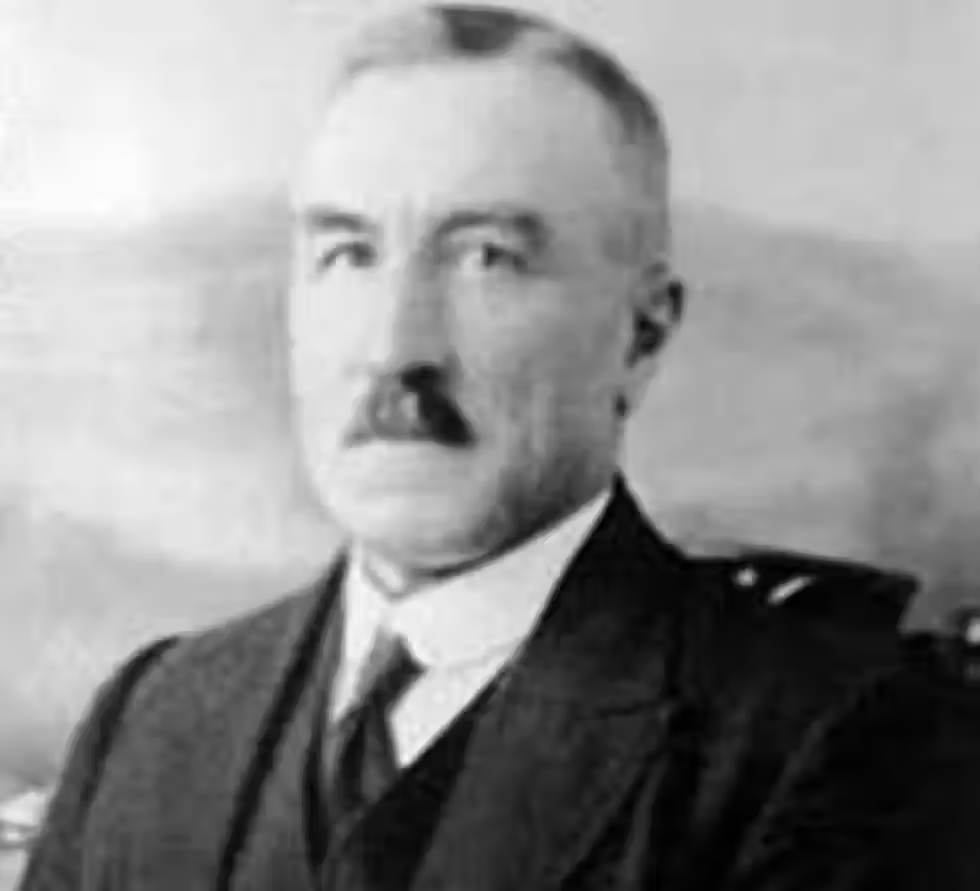
He was known for his professionalism and dignity in performing his duties, including executing enemy agents and civilians during World War II.
Thompson readily submitted to the pinioning and walked without assistance to the scaffold. A more fearless condemned prisoner has rarely been incarcerated in the county gaol. On Sunday, he attended the usual service in the beautiful chapel but was screened from the other inmates.
Reports said that his wife and children never visited him in prison. It is unclear if they even knew about his trial and execution.
Nearly 200 people had gathered outside the Maidstone prison gates, and most of these waited until 8.15, when an official posted up the following notice:
''Certificate of Surgeon William Davies Higson. The surgeon to His Majesty's Prison at Maidstone. Rent. I hereby certify that I have this day examined the body of reg. No 779. Harry Thompson, on whom judgment of death was this day executed in this said prison, and that examination I found that the said Harry was dead. Dated 9th day of March. Signed William Davies Higson"
A similarly worded notice, signed by the Under Sheriff (Mr William H. Whitehead), the Governor of the Gaol (Captain Stevenson), and the chaplain (The Rev. A. F. O.N. Williams), was posted up.
Many people in Maidstone were surprised to hear two bells tolling at the time of the execution—one at St Luke's and one at St. Paul's Church. The bells rang at intervals for about fifteen minutes, and the event was widely discussed in town that day.
An explanation was given by the Vicars of St Paul (The Rev. C. S. T. Watkins) and the Vicar of St Luke. (the Rev. A. Hewitt) to a Kent Messenger representative on Tuesday afternoon.
The Rev. Watkins stated that the bell of his church was rung at the Sheriff's request. St. Paul's Vicar said, "It has always rung just after an execution, because the Prison is in St. Paul's parish. Our bell was rung at the execution at Maidstone and at others before it, and I believe, some years ago, a bell used to be rung in the Prison. I do not know why there should be any controversy over it. We are asked to ring a bell for a person who has died, and we can't refuse. Mr Watkins added that he did not know that the St. Luke's Church bell would also be rung.
The Rev. Hewitt said, "The position is like this, by Government regulations a bell has to be rung somewhere, either in the Prison or its Immediate vicinity, when the execution takes place. On Monday, the prison governor came to me and asked whether the bell of my church might be tolled. At first, I said I would rather it go elsewhere. But as nearly all the warders live in my parish. I later consented. The verger who rang it, I believe, is the recipient of a small sum, but, of course, nothing comes to me'' Mr Hewitt added that it was his opinion that this was the first time a bell had been rung in the Maidstone church for an execution for many years. The tolling on Tuesday he described as a mere passing Bell. “Mourners paid the verger a certain sum in order that he rung it, in memory of the departed, you see'' Mr Hewitt said, "there is nothing in all the rumours that have got about with regard to this. A bell has to be rung somewhere. Previously. I understand they rang a small bell inside the prison, and since there is no fixed bell there, they came to me. There is no truth in the rumour that the bell was rung at my church so that the other prisoners should not be disturbed. Neither does it mean any alteration in the Church's attitude towards murderers."
THE INQUEST
At the prison, the County coroner (Mr A. H Neve) held the Inquest on the body of Harry. Mr W. G Smith was appointed foreman of the jury.
The Coroner explained that there were only two questions which he should leave to their decision: (1) Whether the body which they would view was that of Harry Thompson, who was convicted at the recent Assizes and sentenced to death, and (2) Whether the sentence of the law was duly carried into effect.
The first witness was Captain Stevenson, the Governor, who formally identified the body as that of Harry Thompson of Cross Street, Chatham.
“A coal miner, age 38, was condemned to death for a murder on February 27”. He added that there was no appeal by the prisoner and that the arrangements for the execution were made by the Under-Sheriff, who was present with the witness, the prison doctor and the Chaplain.
The Coroner: “Was the execution carried out in accordance with the law?”
Witness: “Yes.” He further stated that the prisoner died about 8 o'clock or a few seconds after.
Next witness was Dr Higson, the prison surgeon, who stated that the cause of death was a fracture of the vertebra and asphyxia, due to hanging.
The Coroner: “The execution was duly and properly carried out ?”
Witness: “Yes.”
Asked what period elapsed between the time the prisoner left his cell and died
Dr Higson: “One minute, in my opinion, his death was instantaneous.”
The jury then answered the coroner's two questions in the affirmative. This concluded the enquiry.
The Jury were afterwards shown over the Prison.
LIFE AFTER
Albert James was 17 years old at the time of his mother's death.
In 1936, at the age of 26, he married Beatrice E. Twigg, also aged 26, in Chatham. The couple had two children, and he later worked as a builders' lorry driver. He died on 17 March 1988, aged 78, in Wigmore, Gillingham, Kent.
Lillian Rose Florence was 10 years old at the time of her mother's death.
She later moved to London and worked at a manufacturing company. There, she met Charles Herbert Meyrick, who was three years her senior. On 24 July 1937, at the age of 22, they married at St Matthew, Willesden, Brent, London. The couple had no children. She died at the age of 93 on 7 May 2008 in Chatham, Kent.
Rose Mary Kathleen was nine years old at the time of her mother's death.
In 1939, she was employed as a domestic servant at Abbey Farm in Sandling, Hollingbourne, Kent, a property associated with the Boxley Abbey Place estate. In October 1944, at the age of 28, she married James Robert Slattery, aged 36, from Waterslade, the residence of her grandparents. It is possible that she lived with them following her mother's death. The couple had a son, Derek, born in 1946, who did not survive. They subsequently had three more children, a daughter and two sons, who are still living. She died at the age of 88 on 18 June 2005 at 75 Snodhurst Avenue, Chatham, Kent.
Alice Hannah was 7 at the time of her mother's death.
She was sent to the Medway Union House. In 1978, at the age of 59, she married Albert E. Budd, aged 65, from Willesden, Middlesex, in Maidstone. She died age 90, on 13 May 2009 in Chatham, Kent.
SOURCES
SOURCES
⦁ Archive, History’s colourful stories in black and white, Home | British Newspaper Archive. Available at: https://www.britishnewspaperarchive.co.uk/
⦁ (1926, February 12). THE CROSS STREET TRAGEDY. Chatham, Rochester and Brompton Observer, pg3.
⦁ (1926, February 18). I did it, I am guilty. Sheerness Times Guardian, pg5Col4.
⦁ (1926, February 19). The Inquest & The Funeral. Chatham, Rochester and Brompton Observer, pg3.
⦁ (1926, February 26). Kent Assizes. Sevenoaks Chronicle and Kentish Advertiser, pg3.
⦁ (1926, February 26). The Chatham Murder. Dover Express, pg12.
⦁ (1926, February 26). Smiled at death sentence. Chatham, Rochester and Brompton Observer, pg8.
⦁ (1926, March 12). CRIME EXPIATED. Chatham, Rochester and Brompton Observer, pg11.
⦁ (1926, March 13). Chatham murderer executed & The Inquest. Kent Messenger & Gravesend Telegraph, pg7.
⦁ Bring your backstory to life Ancestry® | Genealogy, Family Trees & Family History Records. Available at: http://www.ancestry.co.uk/
⦁ General Register Office (no date) General Register Office - Online Ordering Service - Login. Available at: https://www.gro.gov.uk/gro/content/certificates/
⦁ Pictures and historical info from Wikipedia https://www.wikipedia.org/


Comments